Some time back, a local newspaper golf and sports writer, Tod Leonard, wrote a column (putting style) focused on the many unique putting styles being adopted by even the best PGA pros–Phil Mickelson’s new claw grip on short putts, Adam Scott’s claw grip to replace his now illegal anchored putter, Rory McIlroy going cross-handed and Jordan Spieth who actually looks at the hole while he’s putting. Add to this, Michelle Wie’s awkward looking “table-top” style of putting and its pretty clear that it’s no longer true that anyone not putting in a standardized way is a desperate golfer looking for a quick fix to a serious putting problem.
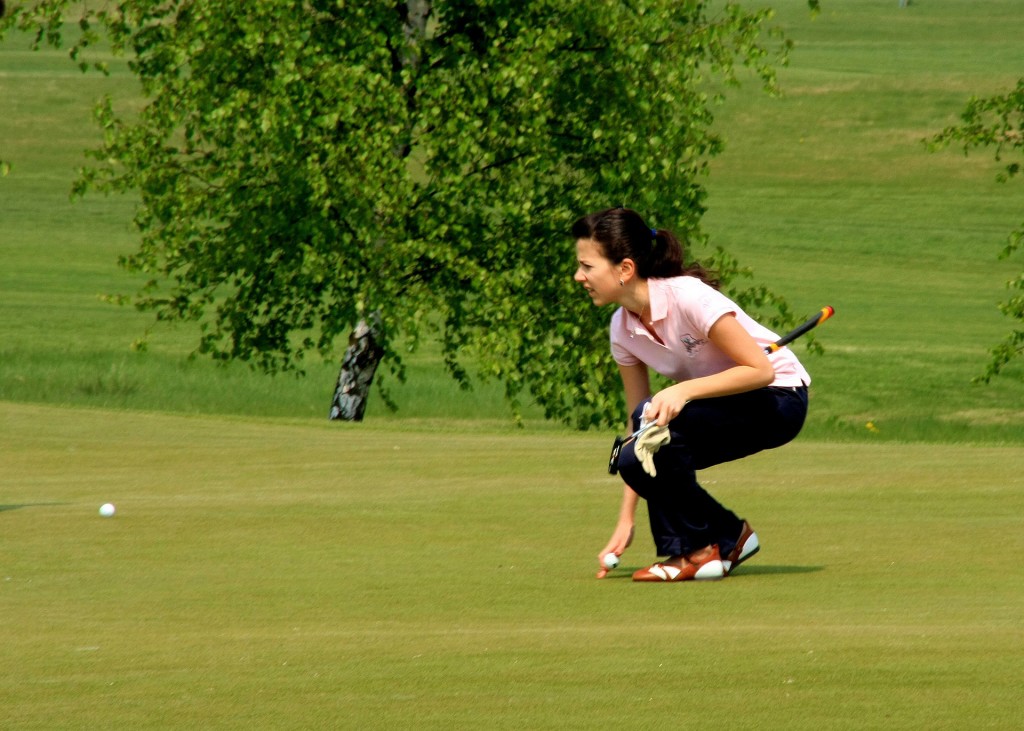
The point to be made is that putting is a very unique part of the game. It requires the least physical skill of any aspect of the game yet it may be the most difficult part of the game (at least responsible for the most dropped shots), largely due to the direct connection between the brain and the putter face. Golf is recognized as a sport in which the mental side is at least as important as the mechanical side of the game; with putting, the mental side is even more important. Uncertainty and self-doubt on the putting green are likely to be immediately translated into missed puts, especially those 3-footers! Robin Sieger, in his book “Silent Mind Putting: How to putt like you never miss”, talks about the difference between hoping the putt goes in and expecting it to. What is it about putting that makes it so susceptible to the intrusion of unwelcome thoughts and emotions at the absolute worst time in the middle of your stroke?
For starters, the precision of the putting stroke deceptively seems to call for fine motor movements of the hands when, in reality, it’s perhaps the one stroke in the game where purely gross motor movements without hands are required. Any of those unwanted thoughts or feelings that creep in while you are standing over the putt tend to activate those very fine motor muscles you need to be completely quiet. The worst case of this problem is, of course, the “yips”, and once a golfer is afflicted with it, that generates its own set of unwanted self-doubts and uncertainty on the greens. But a bad result on the greens attributed to the mental game of golf begs the question of why is putting made so difficult by our minds.
Any shot in golf can be a pressure shot depending upon the circumstances–a tee shot over water, a green surrounded by pot bunkers, a chip from the short side of the pin–but a putt is the most consistent pressure shot. After all, it doesn’t matter how good your previous shots on the hole were if you are putting for birdie or par and you miss the putt. On the pro tour, the putt is the shot most frequently described as “for the championship”. In addition, the putt (or most likely putts) usually is the final shot on any hole. It provides closure to your play on that hole, and it is what you carry away with you to start the next hole. You sink that 20-footer and you head to the next hole with a bounce in your step; you miss that 3-footer and you walk away with your head down and shoulders slumped. In other words, the putt is the quintessential pressure shot in golf, and it can have a tremendous impact on your mindset during the course of a round. No wonder when you’re having a bad day on the greens, the rest of your game likely turns bad by the time you finish 18-holes as the effects of your putting seep into other parts of your game.
If you’ve read our previous posts on resilience (add links to posts here), you know that how you handle those pressure putts–and how you mentally and emotionally handle a bad result–can make all the difference in your round. And how you handle them can also tell you something about how you handle pressure situations off the courses as well. As we so frequently remind readers in this blog, golf, more so then almost any other sport, mirrors life off the course—it offers a great metaphor for how we strategize, problem solve, concentrate, deal with frustrations and stress, and how we contend with a roller coaster of emotions experienced during a round. The golf course offers a real world situation in which to actually observe someone use the wide range of coping skills that a round will require. The extensive sampling of behaviors gathered during a round of golf provides a wealth of information to better understand a person’s coping style and skills.
Not only can your putting mirror how you handle pressure situations generally, it may also say something about the way in which you finish an important piece of work or how you “close the deal”, so to speak. Take a closer and honest look at exactly how you handle those pressure putts on the course to see just what you can learn about your ability to handle pressure situations. Do you lose focus under the spotlight as the pressure of determining success or failure mounts? Or do you bare down at that point and make sure to finish strong with what you set out to do? Do you rush through to get an anxious situation over with? Or do you confidently use your closing opportunity to demonstrate to others just what you are capable of?
Working on your mental game to expect your putts will go in rather than simply hoping they’ll go in will improve your game–both on and off the course.
Tell us about your putting…..and how well you handle pressure.
